
Parenthesis is a word, phrase or clause added to a sentence to give extra information, marked off by a pair of brackets, dashes or commas. In Mr Patel (our head teacher) sang in assembly, the words in brackets are the parenthesis. Children learn it in Year 5.
Try the two practice sets below: Spot it asks your child to find parenthesis in sentences, and Use it asks them to choose the correct one. Every answer is explained.
Three ways to mark parenthesis
| Punctuation | Example | Feels |
|---|---|---|
| Brackets | The Thames (London’s river) is 346 km long. | Quiet, like a side note |
| Dashes | The Thames – London’s river – is 346 km long. | Stronger, draws attention |
| Commas | The Thames, London’s river, is 346 km long. | Smooth, part of the flow |
The Year 5 programme of study lists “brackets, dashes or commas to indicate parenthesis”. All three are correct; the choice changes how much the extra information stands out.
The removal test
Cover the words inside the brackets, dashes or commas. If the sentence still makes complete sense, the punctuation is in the right place: The Thames is 346 km long. If it no longer makes sense, the parenthesis marks are in the wrong place.
Always in pairs (in the middle of a sentence)
When the extra information is in the middle of a sentence, the marks always come in pairs: an opening and a closing bracket, two dashes or two commas. The most common mistake is forgetting the second one: My dog, a spaniel loves the beach needs a comma after spaniel. At the end of a sentence, a single dash or comma can do the job: We went to the beach – in the rain.
What can go inside
- A single word: The answer (surprisingly) was yes.
- A noun phrase: Ada Lovelace, a mathematician, wrote the first computer program.
- A relative clause: My cousin, who lives in Wales, is visiting.
In the Year 6 test
The Key Stage 2 grammar paper can ask children to add a pair of brackets, dashes or commas in the right place, or to explain why they are used. The removal test above answers most of these questions.
Common mistakes
- Mixing marks: (our teacher – must close with a bracket, not a dash.
- Brackets around essential words: I (like) chocolate does not work, because the sentence needs like.
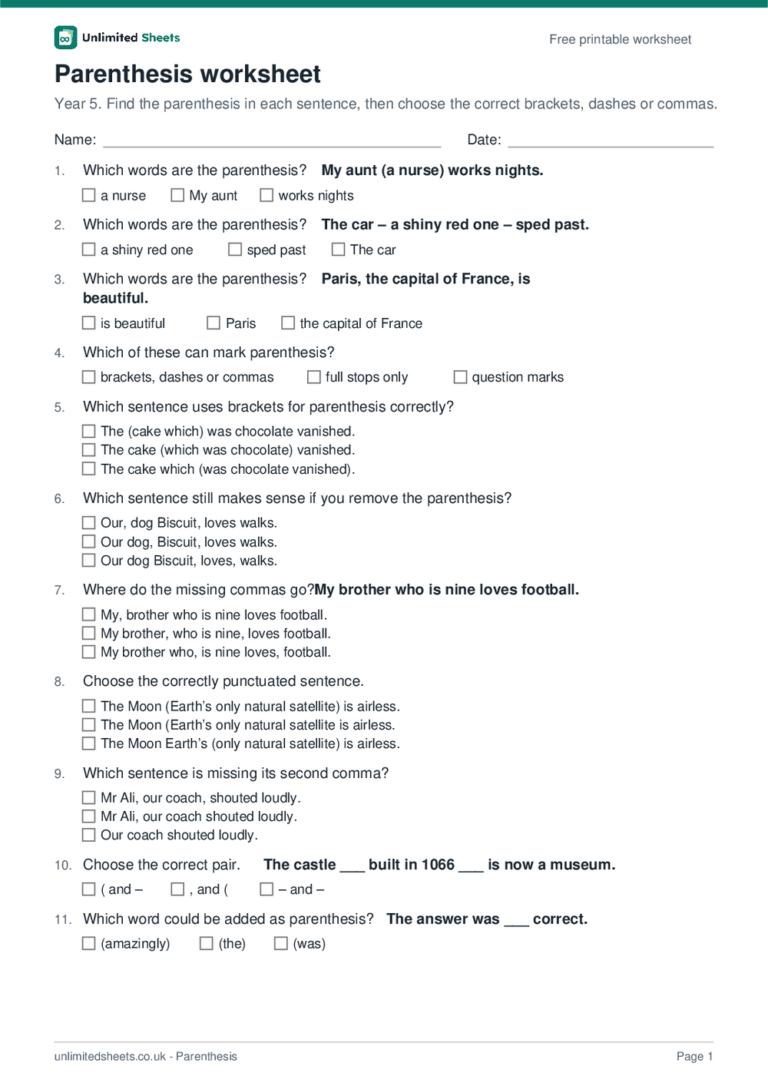
Printable parenthesis worksheet
The worksheet mixes questions that ask your child to spot parenthesis with questions that ask them to use them, each with tick boxes, followed by an answer key. It is A4 and prints in black and white.
Related pages
- By year: Year 5 English.
- More in Punctuation: Apostrophes, Inverted Commas.
- Other grammar terms: Modal Verbs, Conjunctions, Prepositions, Determiners, Relative Clauses, Active and Passive Voice. See them all on the KS2 grammar page.
Sources
National curriculum in England: English programmes of study, including English Appendix 2: vocabulary, grammar and punctuation, Department for Education, GOV.UK.
Updated 23 November 2026.