
The Year 3 and 4 spelling list is a statutory list of 100 words that children in England are expected to spell by the end of Year 4, from accident to woman. It comes from English Appendix 1 of the national curriculum and is shared across both years, so schools decide which words to teach when.
The full list (100 words)
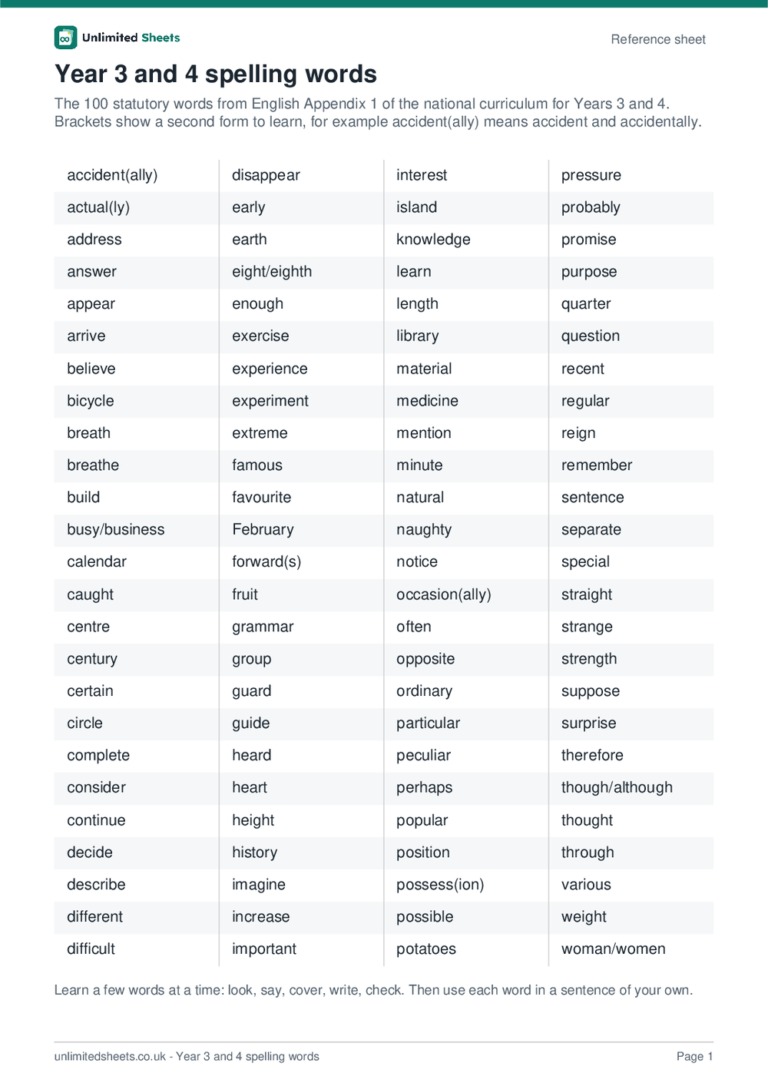
| accident(ally) | disappear | interest | pressure |
| actual(ly) | early | island | probably |
| address | earth | knowledge | promise |
| answer | eight/eighth | learn | purpose |
| appear | enough | length | quarter |
| arrive | exercise | library | question |
| believe | experience | material | recent |
| bicycle | experiment | medicine | regular |
| breath | extreme | mention | reign |
| breathe | famous | minute | remember |
| build | favourite | natural | sentence |
| busy/business | February | naughty | separate |
| calendar | forward(s) | notice | special |
| caught | fruit | occasion(ally) | straight |
| centre | grammar | often | strange |
| century | group | opposite | strength |
| certain | guard | ordinary | suppose |
| circle | guide | particular | surprise |
| complete | heard | peculiar | therefore |
| consider | heart | perhaps | though/although |
| continue | height | popular | thought |
| decide | history | position | through |
| describe | imagine | possess(ion) | various |
| different | increase | possible | weight |
| difficult | important | potatoes | woman/women |
Practise the words
Look, cover, write shows each word for a few seconds, then asks your child to type it from memory. Spot it shows the word spelt correctly next to common misspellings. Both mark themselves.
The words grouped by pattern
Learning words in groups that share a trap is faster than learning them in alphabetical order.
| Pattern | Words from the list | Tip |
|---|---|---|
| Silent letters | answer, build, guard, guide, island, knowledge, reign, straight | Say the silent letter out loud when practising: “is-LAND”. |
| -ough and -augh | enough, though, although, thought, through, caught, naughty | Same letters, different sounds: learn each one separately. |
| Double letters | address, appear, arrive, different, difficult, disappear, occasion, opposite, possess, possible, pressure, accident | Clap the syllables: the double letter usually sits on a syllable break. |
| Soft c (c that says s) | bicycle, centre, century, certain, circle, decide, exercise, experience, medicine, notice, recent, sentence | c says /s/ before e, i or y. |
| ear that says er | early, earth, heard, learn | Not to be confused with heart, where ear says /ar/. |
| Swallowed syllables | February, library, probably, different, interest, ordinary, separate, favourite, history | Say every syllable when spelling: Feb-ru-ar-y, lib-rar-y. |
| eigh | eight, eighth, weight, height | Height is the odd one out: eigh says /eye/. |
| Word pairs | breath/breathe, busy/business, woman/women | Learn both forms together and say what changes. |
How to learn the list
A hundred words over two school years is roughly 50 a year, or one or two new words a week. Our Year 3 spelling page practises the first 50 words of the list and Year 4 spelling the second 50, so you can split it the same way. Words in brackets, such as accident(ally), mean both forms are on the list: accident and accidentally.
- Find the tricky part of each word and underline it.
- Look, say, cover, write, check a few words at a time.
- Use each word in a sentence the same day.
- Revisit last week’s words before starting new ones.
Why these words?
The curriculum describes the Key Stage 2 lists as a mix of words that pupils use often in their writing and words they often spell wrongly. That is why everyday words such as believe and separate sit next to topic words such as century and medicine.
Printable sheets
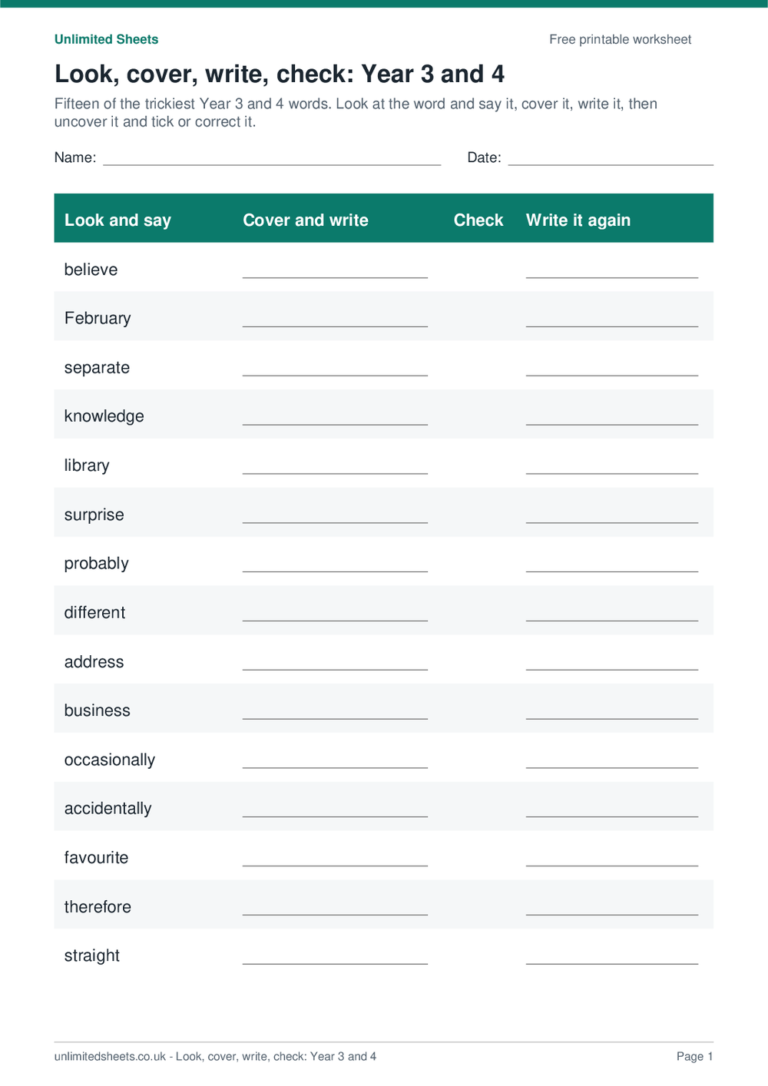
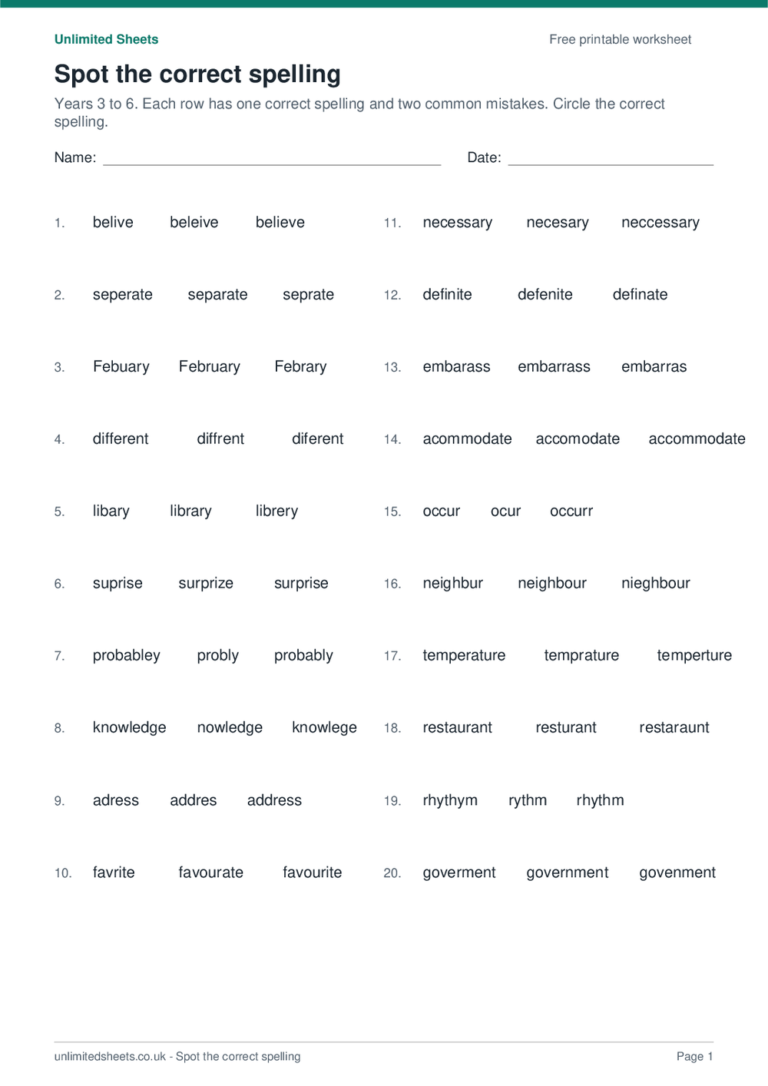
A printable copy of the list, a look-cover-write-check sheet and a spot-the-spelling worksheet with answers.
Related pages
Before this list come the Year 2 common exception words; next is the Year 5 and 6 spelling list. Spelling rules for these years are on prefixes, suffixes and homophones.
Sources
National curriculum in England: English programmes of study, English Appendix 1: spelling, Department for Education, GOV.UK.
Updated 23 November 2026.