
Homophones are words that sound the same but are spelt differently and mean different things, such as there, their and they’re, or see and sea. Because they sound identical, the only way to choose the right spelling is to think about the meaning. Homophones appear in the spelling lists from Year 2 to Year 6.
Try the two practice sets below: Spot it asks your child to find homophones in sentences, and Use it asks them to choose the correct one. Every answer is explained.
Homophones by year group
| Year | Examples from the curriculum |
|---|---|
| Year 2 | there/their/they’re, here/hear, quite/quiet, see/sea, bare/bear, one/won, sun/son, to/too/two, be/bee, blue/blew, night/knight |
| Years 3 and 4 | accept/except, affect/effect, ball/bawl, berry/bury, brake/break, fair/fare, grate/great, groan/grown, heel/heal, knot/not, mail/male, main/mane, meat/meet, medal/meddle, missed/mist, peace/piece, plain/plane, rain/rein/reign, scene/seen, weather/whether, whose/who’s |
| Years 5 and 6 | aisle/isle, aloud/allowed, altar/alter, cereal/serial, compliment/complement, desert/dessert, draft/draught, guessed/guest, heard/herd, led/lead, morning/mourning, past/passed, precede/proceed, principal/principle, profit/prophet, stationary/stationery, steal/steel, wary/weary, who’s/whose |
Some pairs are near-homophones: they sound alike but not quite the same, such as accept and except, or affect and effect. The curriculum lists them together because they cause the same mistakes.
Tricks for the trickiest sets
- there, their, they’re: there has here inside it (a place); their has heir inside it (belonging); they’re has an apostrophe because it means they are.
- to, too, two: too has too many o’s (it means “also” or “more than enough”); two is the number, like twin and twelve.
- stationary, stationery: stationery with an e is envelopes; stationary with an a means standing still.
- desert, dessert: dessert has two s’s because you always want seconds of pudding.
- affect, effect: affect is usually the action (a verb); effect is the end result (a noun).
How to practise homophones
Practising the letters alone does not help, because the sound gives no clue. Put each spelling in a short sentence and talk about the meaning: I can hear with my ear. Then ask your child to choose the right word in new sentences, as the practice above does. When writing, a quick check is to swap in the meaning: if they are fits, write they’re.
Common mistakes
- Who’s and whose: who’s means who is or who has; whose asks about belonging.
- Past and passed: passed is the verb (we passed the shop); past is about time or position (in the past, we walked past).
- Practice and practise: in British English, the noun ends in -ice and the verb in -ise, like advice and advise.
Printable homophones worksheet
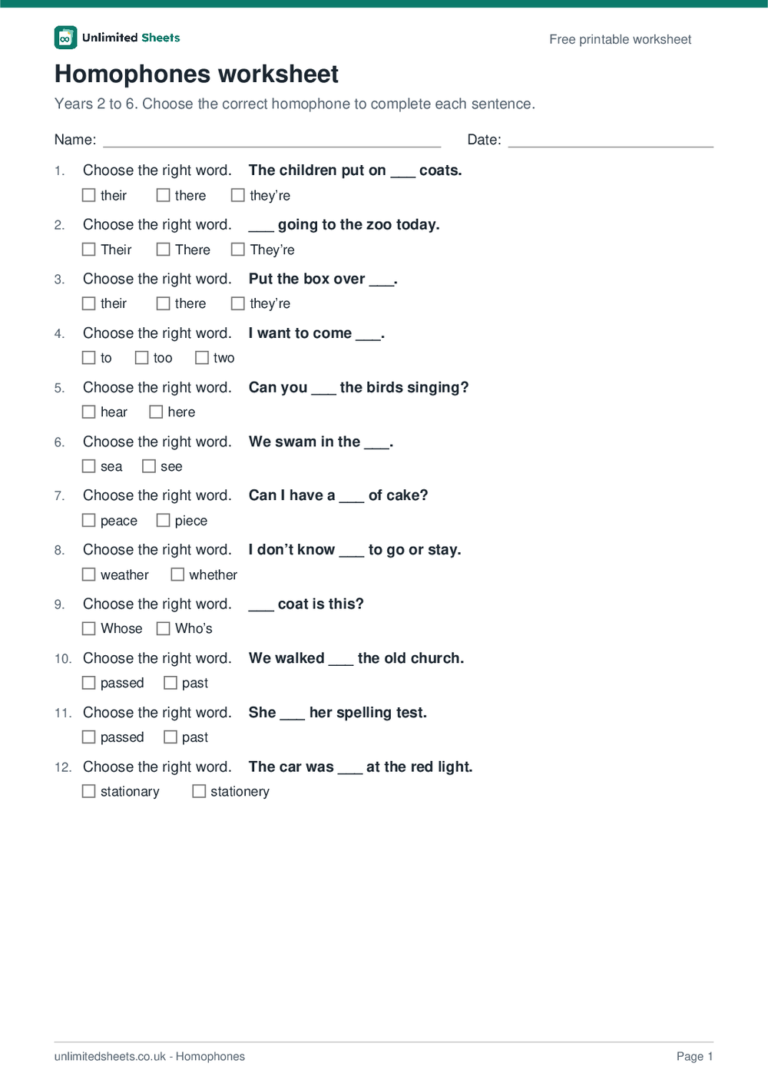
The worksheet mixes questions that ask your child to spot homophones with questions that ask them to use them, each with tick boxes, followed by an answer key. It is A4 and prints in black and white.
Related pages
- By year: Year 2 spelling, Year 3 spelling, Year 5 spelling.
- More in Spelling words: Prefixes, Suffixes.
- Other grammar terms: Modal Verbs, Conjunctions, Prepositions, Determiners, Relative Clauses, Active and Passive Voice. See them all on the KS2 grammar page.
Sources
National curriculum in England: English programmes of study, including English Appendix 1: spelling, Department for Education, GOV.UK.
Updated 23 November 2026.