
A prefix is a group of letters added to the beginning of a word to make a new word with a different meaning. Adding un- to happy makes unhappy; adding re- to build makes rebuild. Children meet un- in Year 1 and many more prefixes from Year 3 onwards.
Try the two practice sets below: Spot it asks your child to find prefixes in sentences, and Use it asks them to choose the correct one. Every answer is explained.
Prefixes and their meanings
| Prefix | Meaning | Examples | Year |
|---|---|---|---|
| un- | not, opposite | unkind, undo, unlock | 1 |
| dis- | not, opposite | disagree, disappear, dislike | 3–4 |
| mis- | wrongly | misbehave, misspell, mislead | 3–4 |
| in-, il-, im-, ir- | not | incorrect, illegal, impossible, irregular | 3–4 |
| re- | again, back | redo, refresh, return | 3–4 |
| sub- | under | submarine, subway, subheading | 3–4 |
| inter- | between, among | international, interact | 3–4 |
| super- | above, beyond | supermarket, superstar | 3–4 |
| anti- | against | antiseptic, anticlockwise | 3–4 |
| auto- | self, own | autograph, autobiography | 3–4 |
| de-, over- | reverse; too much | defrost, overflow | 5 |
The spelling rule
Adding a prefix never changes the spelling of the root word. That is why some words end up with double letters: mis + spell = misspell, dis + satisfied = dissatisfied, un + necessary = unnecessary, il + legal = illegal. Knowing this rule fixes one of the most common Year 5 and 6 spelling mistakes.
in-, il-, im- or ir-?
All four mean “not”, and the choice depends on the first letter of the root word. Before l, use il- (illegible). Before m or p, use im- (immature, impatient). Before r, use ir- (irresponsible). Most other words take in- (inactive, incomplete).
Year 5: verb prefixes
The Year 5 programme of study adds verb prefixes such as dis-, de-, mis-, over- and re-, used to make new verbs: calculate → miscalculate, activate → deactivate, see → oversee, appear → reappear.
Prefixes and word families
Prefixes help children work out new words. If you know sub- means “under” and marine is about the sea, submarine makes sense. The Year 3 programme of study links this to word families, such as solve, solution and dissolve.
Common mistakes
- Dropping a letter: mispell and unecessary lose a letter from the root word.
- Hyphens: most prefixes join the word without a hyphen. A hyphen is used when the root starts with a capital (un-British) or to avoid confusion (re-cover a sofa, not recover from illness).
Printable prefixes worksheet
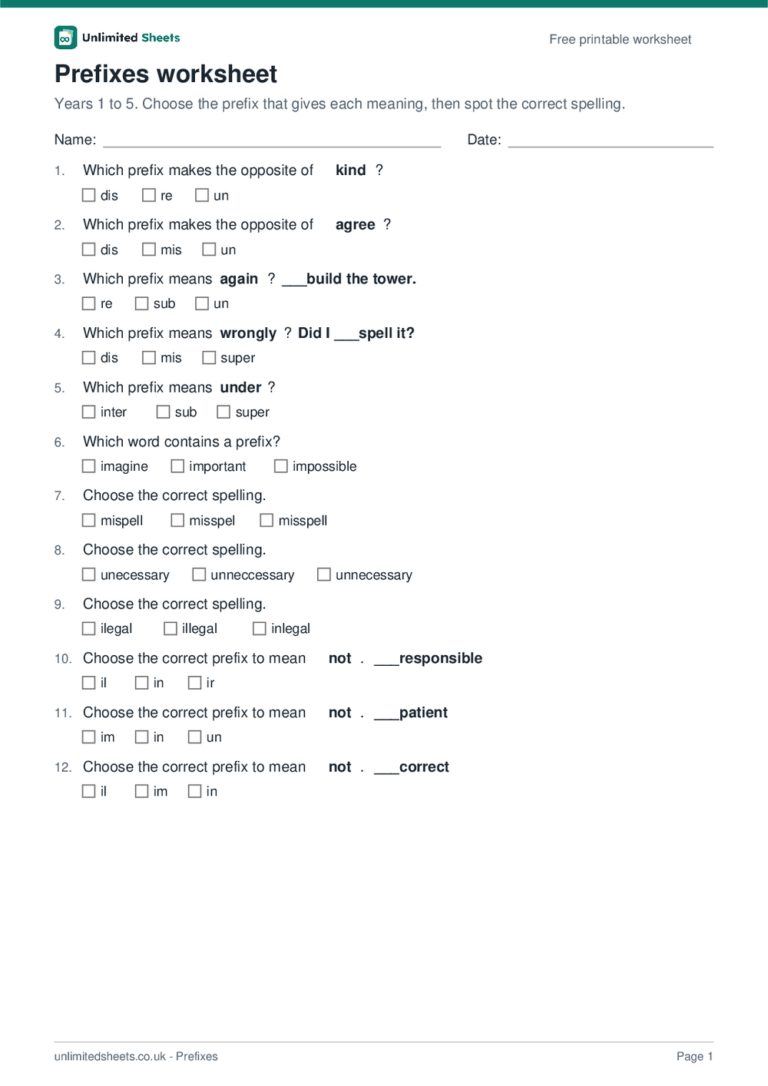
The worksheet mixes questions that ask your child to spot prefixes with questions that ask them to use them, each with tick boxes, followed by an answer key. It is A4 and prints in black and white.
Related pages
- By year: Year 3 spelling, Year 3 grammar, Year 5 English.
- More in Spelling words: Homophones, Suffixes.
- Other grammar terms: Modal Verbs, Conjunctions, Prepositions, Determiners, Relative Clauses, Active and Passive Voice. See them all on the KS2 grammar page.
Sources
National curriculum in England: English programmes of study, including English Appendix 1: spelling, Department for Education, GOV.UK.
Updated 23 November 2026.