
The Year 5 and 6 spelling list is a statutory list of 100 harder words that children in England are expected to spell by the end of primary school, from accommodate to yacht. It comes from English Appendix 1 of the national curriculum, and words like these turn up in the spelling paper of the Year 6 SATs.
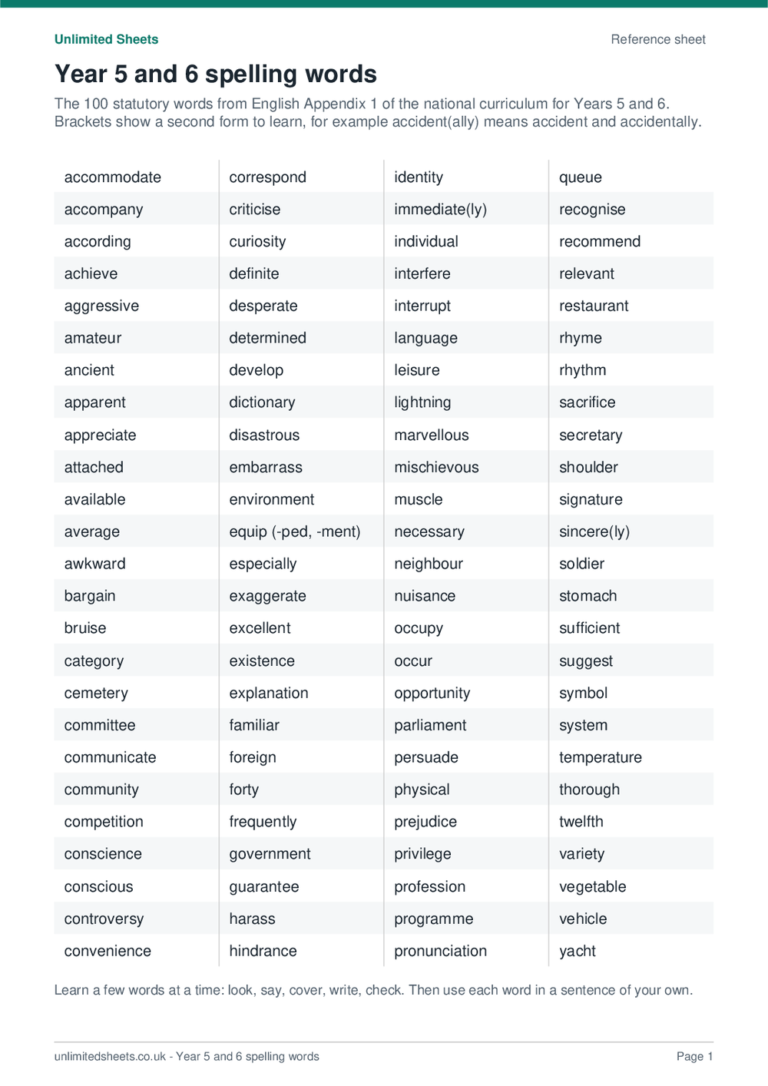
The full list (100 words)
| accommodate | correspond | identity | queue |
| accompany | criticise (critic + ise) | immediate(ly) | recognise |
| according | curiosity | individual | recommend |
| achieve | definite | interfere | relevant |
| aggressive | desperate | interrupt | restaurant |
| amateur | determined | language | rhyme |
| ancient | develop | leisure | rhythm |
| apparent | dictionary | lightning | sacrifice |
| appreciate | disastrous | marvellous | secretary |
| attached | embarrass | mischievous | shoulder |
| available | environment | muscle | signature |
| average | equip (–ped, –ment) | necessary | sincere(ly) |
| awkward | especially | neighbour | soldier |
| bargain | exaggerate | nuisance | stomach |
| bruise | excellent | occupy | sufficient |
| category | existence | occur | suggest |
| cemetery | explanation | opportunity | symbol |
| committee | familiar | parliament | system |
| communicate | foreign | persuade | temperature |
| community | forty | physical | thorough |
| competition | frequently | prejudice | twelfth |
| conscience | government | privilege | variety |
| conscious | guarantee | profession | vegetable |
| controversy | harass | programme | vehicle |
| convenience | hindrance | pronunciation | yacht |
Practise the words
Look, cover, write shows each word for a few seconds, then asks your child to type it from memory. Spot it shows the word spelt correctly next to common misspellings. Both mark themselves.
The words grouped by pattern
Learning words in groups that share a trap is faster than learning them in alphabetical order.
| Pattern | Words from the list | Tip |
|---|---|---|
| Double letters | accommodate, accompany, aggressive, apparent, appreciate, attached, committee, communicate, community, correspond, embarrass, exaggerate, immediate, interrupt, necessary, occupy, occur, opportunity, recommend, suggest, sufficient | Necessary: one collar (c), two sleeves (ss). Embarrass: two r, two s. |
| Single where you expect double | harass, develop | Harass has one r and two s; develop has no e at the end. |
| ie and ei | achieve, ancient, conscience, foreign, leisure, neighbour, soldier, sufficient, mischievous | The “i before e except after c” rhyme breaks for many of these, so learn them as words. |
| Silent letters | muscle, rhyme, rhythm, yacht, government, parliament, queue, conscious | Rhythm has no vowel except y: “Rhythm Helps Your Two Hips Move”. |
| Hidden vowels | average, category, cemetery, definite, desperate, environment, familiar, temperature, vegetable, marvellous, privilege, secretary | Say them in “spelling voice”: tem-per-a-ture, veg-e-ta-ble. |
| -ence, -ance, -ent | convenience, existence, excellent, relevant, hindrance | Existence and excellent both use e; hindrance uses a. |
| Famous traps | forty, twelfth, pronunciation, mischievous, lightning | Forty has no u; twelfth keeps the f; pronunciation has no “nounce”; lightning has no e. |
How to learn the list
A hundred words over Years 5 and 6 is about 50 a year. Our Year 5 spelling page practises the first 50 words and Year 6 spelling the second 50. Before the SATs in May of Year 6, a quick test of the whole list shows which words still need work.
- Find the tricky part of each word and underline it.
- Look, say, cover, write, check a few words at a time.
- Use each word in a sentence the same day.
- Revisit last week’s words before starting new ones.
The list and the Year 6 spelling test
The Key Stage 2 grammar, punctuation and spelling test includes a 20-word spelling paper. The words are read aloud in sentences, so practising words in context, not just in lists, is the best preparation. The test can include words from any of the spelling patterns in Appendix 1, not only from this list.
Printable sheets
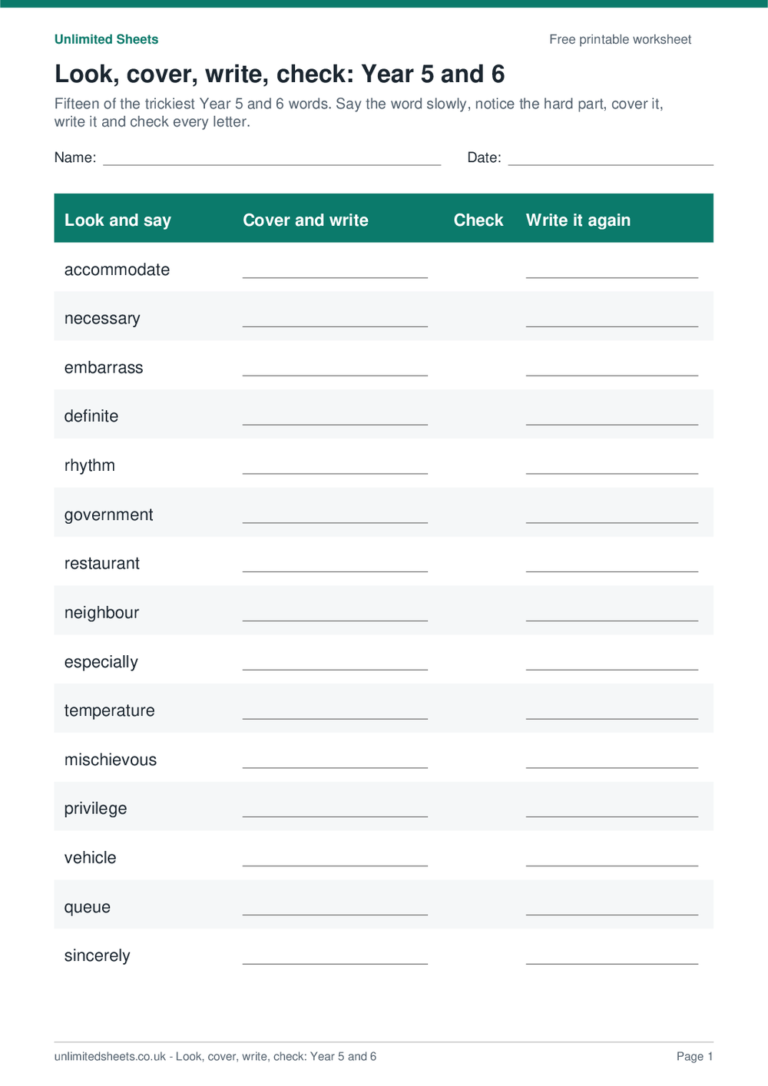
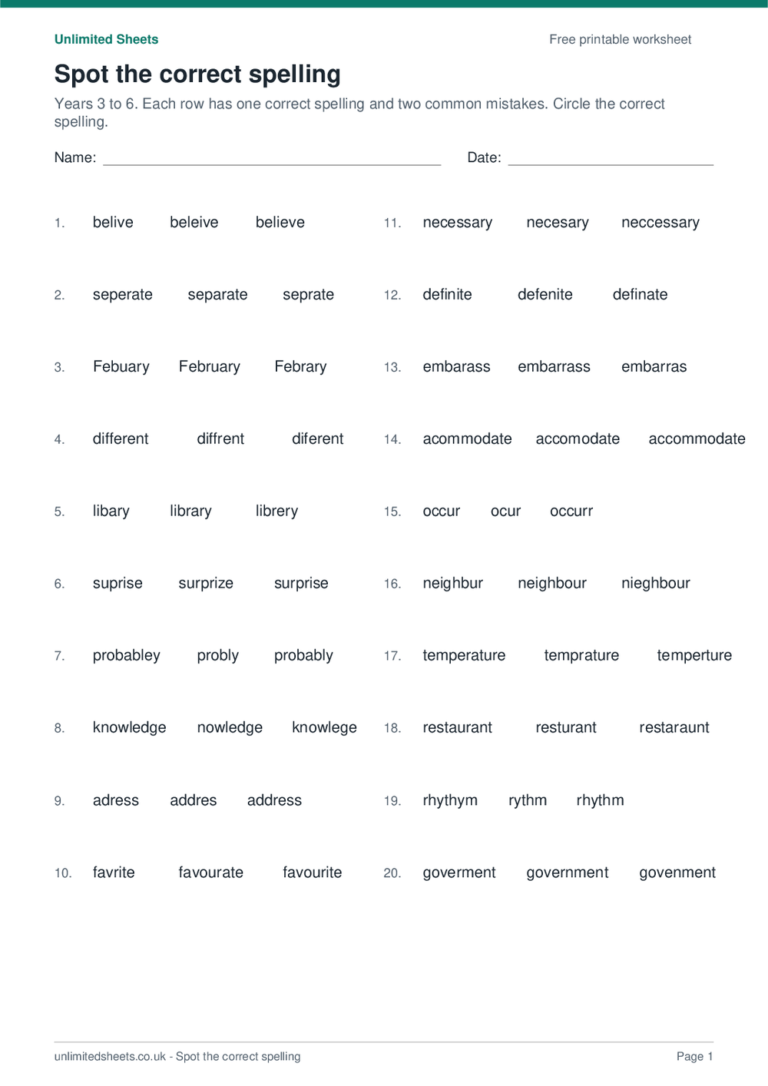
A printable copy of the list, a look-cover-write-check sheet and a spot-the-spelling worksheet with answers.
Related pages
Earlier lists: the Year 3 and 4 spelling list and the Year 2 common exception words. For the rules behind many of these words, see suffixes, prefixes and homophones, and for test dates the Year 6 English page.
Sources
National curriculum in England: English programmes of study, English Appendix 1: spelling, Department for Education, GOV.UK.
Updated 23 November 2026.