
A suffix is a group of letters added to the end of a word to make a new word or a new form of the word. Adding -ful to care makes careful; adding -ness to kind makes kindness. Suffixes are taught in every year from Year 1 to Year 6.
Try the two practice sets below: Spot it asks your child to find suffixes in sentences, and Use it asks them to choose the correct one. Every answer is explained.
Suffixes by year group
| Year | Suffixes | Examples |
|---|---|---|
| Year 1 | -s, -es, -ing, -ed, -er, -est | helping, jumped, quicker, quickest |
| Year 2 | -ment, -ness, -ful, -less, -ly | enjoyment, sadness, playful, hopeless, sadly |
| Years 3 and 4 | -ation, -ly, -ous, -tion, -sion, -ssion, -cian | information, famous, invention, division, discussion, musician |
| Years 5 and 6 | -cious, -tious, -cial, -tial, -ant, -ance, -ent, -ence, -able, -ible | vicious, ambitious, official, partial, observant, hesitancy, innocence, adorable, possible |
| Year 5 (verbs) | -ate, -ise, -ify | activate, apologise, simplify |
Three spelling rules for adding suffixes
- Drop the e: if the root ends in e and the suffix starts with a vowel, drop the e: hope → hoping, adore → adorable. Keep it before a consonant suffix: hope → hopeful.
- Change y to i: if the root ends in a consonant + y, change the y to i: happy → happiness, carry → carried. Keep the y before -ing: carrying.
- Double the consonant: after a single short vowel, double the last consonant before a vowel suffix: run → running, stop → stopped, big → biggest.
Suffixes change the word class
Many suffixes turn one word class into another, which is why they matter in grammar as well as spelling:
- noun or adjective → verb: -ate, -ise, -ify (pure → purify)
- verb → noun: -ment, -ation, -er (enjoy → enjoyment)
- adjective → noun: -ness (dark → darkness)
- noun → adjective: -ful, -less, -ous (danger → dangerous)
- adjective → adverb: -ly (quick → quickly)
The tricky endings
-tion, -sion, -ssion and -cian all sound like “shun”. A useful guide: -cian is for people’s jobs (musician, electrician); -sion often follows words ending in d or de (extend → extension, decide → decision); -ssion follows ss or mit (discuss → discussion, permit → permission); -tion is the most common.
Common mistakes
- -ful with two l’s: the suffix is always -ful: beautiful, hopeful.
- -able or -ible: if a whole word is left when you remove the ending, it is usually -able (dependable); if not, usually -ible (possible, horrible).
Printable suffixes worksheet
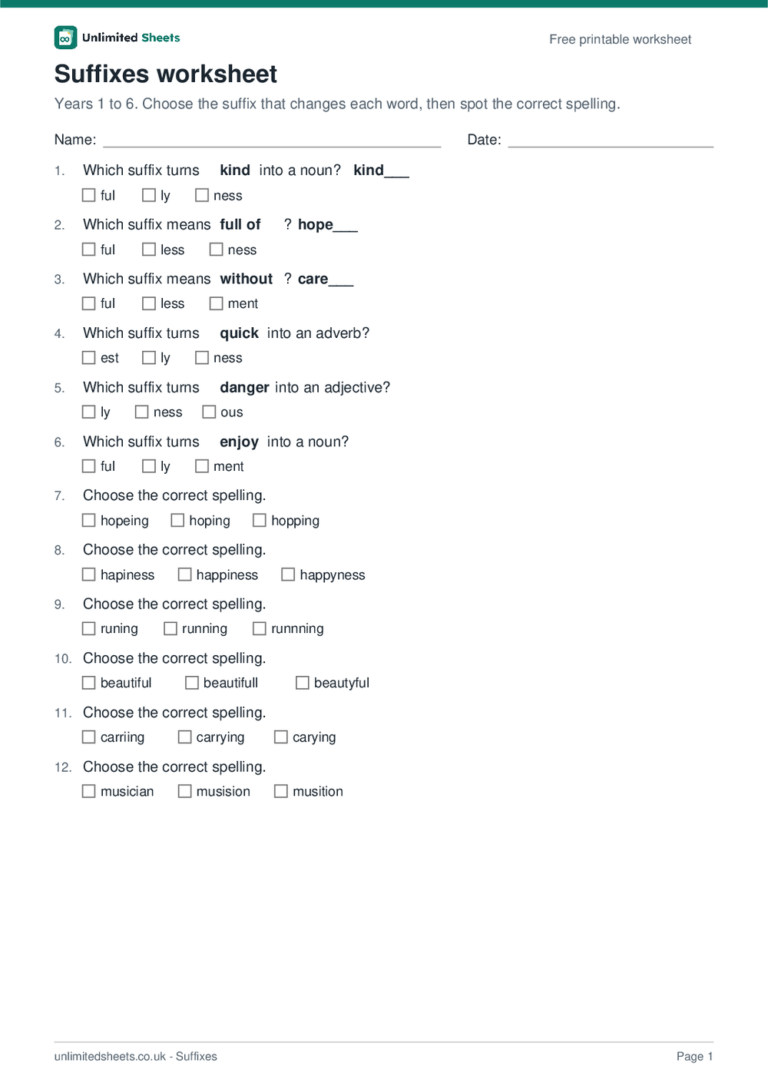
The worksheet mixes questions that ask your child to spot suffixes with questions that ask them to use them, each with tick boxes, followed by an answer key. It is A4 and prints in black and white.
Related pages
- By year: Year 2 spelling, Year 4 spelling, Year 6 spelling.
- More in Spelling words: Homophones, Prefixes.
- Other grammar terms: Modal Verbs, Conjunctions, Prepositions, Determiners, Relative Clauses, Active and Passive Voice. See them all on the KS2 grammar page.
Sources
National curriculum in England: English programmes of study, including English Appendix 1: spelling, Department for Education, GOV.UK.
Updated 23 November 2026.