
An adverb adds information to a verb: it tells you how, when, where or how often something happens. In The owl hooted softly outside, softly says how and outside says where. Children learn the word adverb in Year 2, when they also turn adjectives into adverbs with -ly.
Try the two practice sets below: Spot it asks your child to find adverbs in sentences, and Use it asks them to choose the correct one. Every answer is explained.
Kinds of adverb
| Question it answers | Examples | In a sentence |
|---|---|---|
| How? (manner) | quickly, carefully, well, fast | She wrote carefully. |
| When? (time) | now, then, soon, yesterday, later | We left early. |
| Where? (place) | here, outside, upstairs, nearby | The cat slept upstairs. |
| How often? (frequency) | always, often, sometimes, never | He never forgets. |
| How likely? (possibility) | perhaps, maybe, surely, probably, definitely | Perhaps it will snow. |
Turning adjectives into adverbs with -ly
The Year 2 programme of study asks children to use -ly “to turn adjectives into adverbs”. Most words just add -ly: sad → sadly. Watch three spelling rules:
- Consonant + y becomes -ily: happy → happily, easy → easily.
- -le becomes -ly: gentle → gently, simple → simply.
- -ic adds -ally: basic → basically (but public → publicly).
Not every adverb ends in -ly (soon, often, here), and not every -ly word is an adverb: friendly, lovely and lonely are adjectives, because they describe nouns.
Adverbs through the years
- Year 3: adverbs such as then, next, soon and therefore show time and cause and link ideas.
- Year 4: an adverb or phrase moved to the start of a sentence becomes a fronted adverbial, followed by a comma: Suddenly, the lights went out.
- Year 5: adverbs such as perhaps and surely show degrees of possibility, alongside modal verbs.
Where adverbs go
Adverbs can move around the sentence, which changes the emphasis: Slowly, the door opened. The door slowly opened. The door opened slowly. Moving an adverb to the front is one of the easiest ways to vary how sentences start.
Common mistakes
- Using the adjective instead: He spoke quiet should be He spoke quietly.
- Good and well: good is an adjective, well is the adverb. She played well, not She played good.
- Spelling -ly words: happyly and gentlely should be happily and gently.
Printable adverbs worksheet
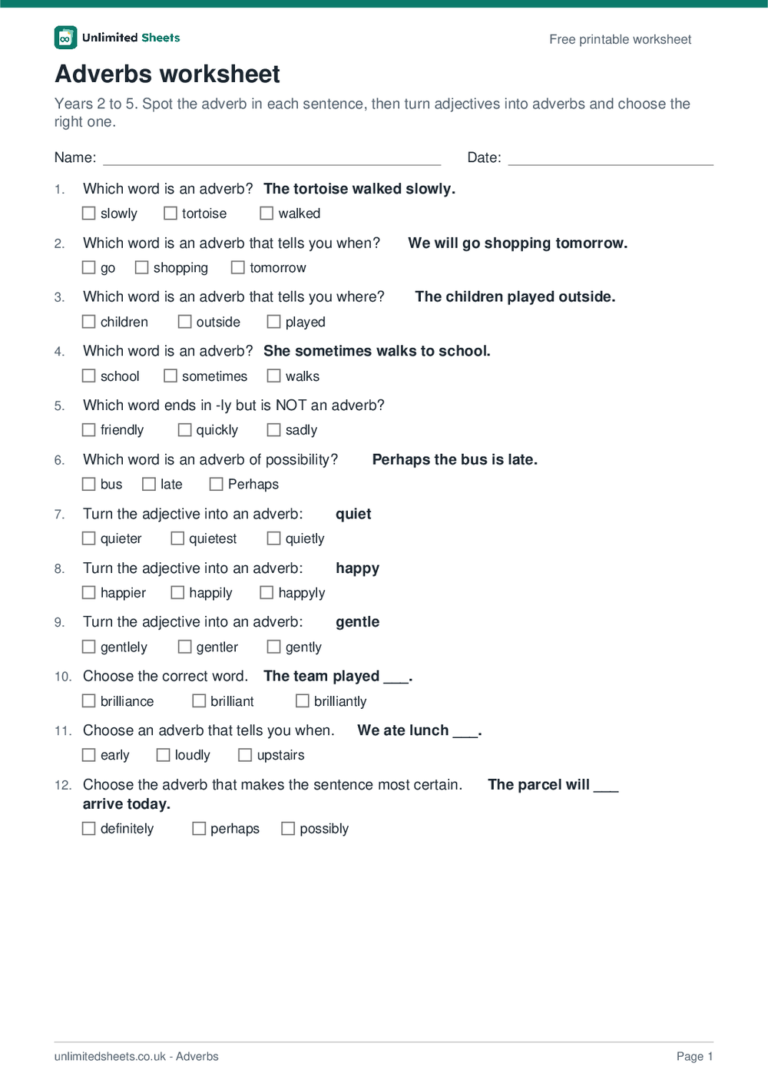
The worksheet mixes questions that ask your child to spot adverbs with questions that ask them to use them, each with tick boxes, followed by an answer key. It is A4 and prints in black and white.
Related pages
- By year: Year 2 grammar, Year 3 grammar, Year 4 grammar, Year 5 grammar.
- More in Word classes: Modal Verbs, Conjunctions, Prepositions, Determiners, Nouns, Adjectives, Pronouns.
- Other grammar terms: Relative Clauses, Active and Passive Voice, Apostrophes, Inverted Commas, Parenthesis, Homophones. See them all on the KS2 grammar page.
Sources
National curriculum in England: English programmes of study, including English Appendix 2: vocabulary, grammar and punctuation, Department for Education, GOV.UK.
Updated 23 November 2026.