
A noun is a naming word: it names a person, an animal, a place, a thing or an idea. In The farmer fed the hens in the barn, the nouns are farmer, hens and barn. Children add -s and -es to make plural nouns in Year 1 and learn the word noun in Year 2.
Try the two practice sets below: Spot it asks your child to find nouns in sentences, and Use it asks them to choose the correct one. Every answer is explained.
Types of noun
| Type | What it names | Examples |
|---|---|---|
| Common noun | Any person, animal, place or thing, not a particular one | girl, horse, city, spoon |
| Proper noun | A particular person, place, day or month; it starts with a capital letter | Aisha, Cardiff, Tuesday, March |
| Collective noun | A group | a flock of sheep, a swarm of bees, a team of players |
| Abstract noun | An idea or feeling you cannot touch | kindness, bravery, fear, freedom |
| Compound noun | Two words joined to make one noun | whiteboard, football, toothbrush |
The national curriculum does not ask children to name every type, but these labels help them spot nouns and use capital letters correctly.
A quick test for a noun
Try putting the, a or some in front of the word. If it makes sense, as in the rabbit, an idea or some happiness, the word is probably a noun. Words such as run can be nouns or verbs, so look at the job the word does in its sentence: a run (noun), we run (verb). In Year 3, children learn to choose a or an by the sound that follows: a rock, an open box.
Singular and plural nouns
- Most nouns add -s: dog, dogs; book, books.
- Nouns ending in s, x, z, ch or sh add -es: box, boxes; wish, wishes; church, churches.
- Consonant + y becomes -ies: baby, babies; but key, keys.
- Some are irregular: child, children; mouse, mice; sheep, sheep.
Making new nouns
In Year 2, children make nouns with suffixes such as -ness (dark → darkness) and -er (paint → painter) and by joining two words (white + board → whiteboard). In Year 3 they add prefixes such as super-, anti- and auto-: supermarket, antifreeze, autopilot.
Noun phrases
A noun phrase is a noun with other words that tell you more about it. Year 2 children write the blue butterfly; by Year 4 they expand it with adjectives, nouns and preposition phrases: the strict maths teacher with curly hair. The noun the phrase is built around (teacher) is called the head noun.
Common mistakes
- Forgetting capitals on proper nouns: we went to wales should be We went to Wales.
- Using an apostrophe for a plural: three apple's should be three apples. An apostrophe shows possession or a missing letter, not a plural.
- Thinking a noun must be a thing you can touch: friendship and courage are nouns too.
Printable nouns worksheet
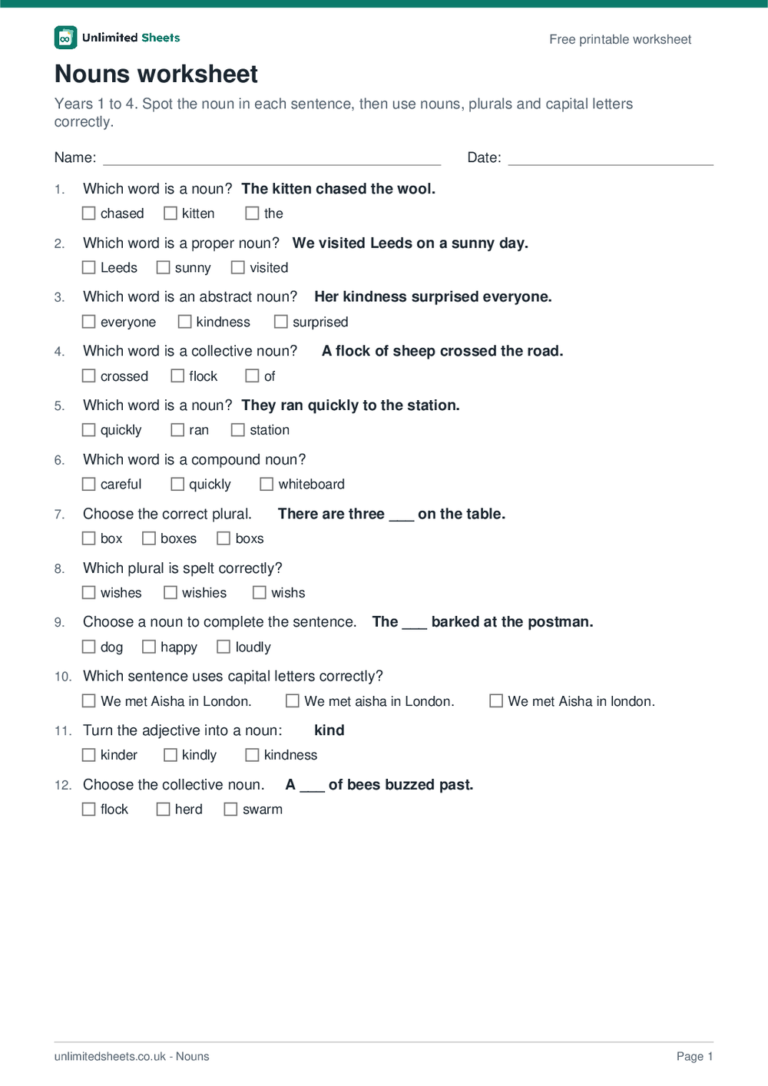
The worksheet mixes questions that ask your child to spot nouns with questions that ask them to use them, each with tick boxes, followed by an answer key. It is A4 and prints in black and white.
Related pages
- By year: Year 1 English, Year 2 grammar, Year 3 grammar, Year 4 grammar.
- More in Word classes: Modal Verbs, Conjunctions, Prepositions, Determiners, Adjectives, Adverbs, Pronouns.
- Other grammar terms: Relative Clauses, Active and Passive Voice, Apostrophes, Inverted Commas, Parenthesis, Homophones. See them all on the KS2 grammar page.
Sources
National curriculum in England: English programmes of study, including English Appendix 2: vocabulary, grammar and punctuation, Department for Education, GOV.UK.
Updated 23 November 2026.