
An adjective is a describing word: it tells you more about a noun. In The hungry fox crept past the sleepy hens, the adjectives are hungry and sleepy. Children learn the word adjective in Year 2, when they also add -er and -est to compare things.
Try the two practice sets below: Spot it asks your child to find adjectives in sentences, and Use it asks them to choose the correct one. Every answer is explained.
Where adjectives go
Most adjectives can sit in two places:
- Before the noun: a muddy boot, the ancient castle.
- After a verb such as is, was, seems or looks: The boot was muddy. The castle looks ancient.
To check, ask “What is it like?” about the noun. The answer is usually an adjective.
Comparing: -er, -est, more and most
| Adjective | Comparing two (comparative) | Comparing three or more (superlative) |
|---|---|---|
| fast | faster | fastest |
| big | bigger | biggest |
| happy | happier | happiest |
| difficult | more difficult | most difficult |
| good | better | best |
| bad | worse | worst |
Short adjectives add -er and -est; long ones use more and most. Never use both: more faster and most best are not Standard English.
Making adjectives
In Year 2, children make adjectives from nouns with the suffixes -ful and -less: hope → hopeful, hopeless; care → careful, careless. Note the spelling: the suffix is -ful with one l. In Year 1 they meet the prefix un-, which turns an adjective into its opposite: kind → unkind, happy → unhappy.
Choosing good adjectives
In Year 4, children build noun phrases with “modifying adjectives”, choosing words that add real information rather than piling them up. The rusty gate paints a clearer picture than the nice old big gate. When two adjectives come before a noun, a comma can separate them if each describes the noun on its own: a cold, dark night.
Common mistakes
- Using an adjective where an adverb is needed: She ran quick should be She ran quickly, because the word describes the verb.
- Doubling up comparisons: more taller should be taller.
- Irregular forms: gooder and baddest should be better and worst.
Printable adjectives worksheet
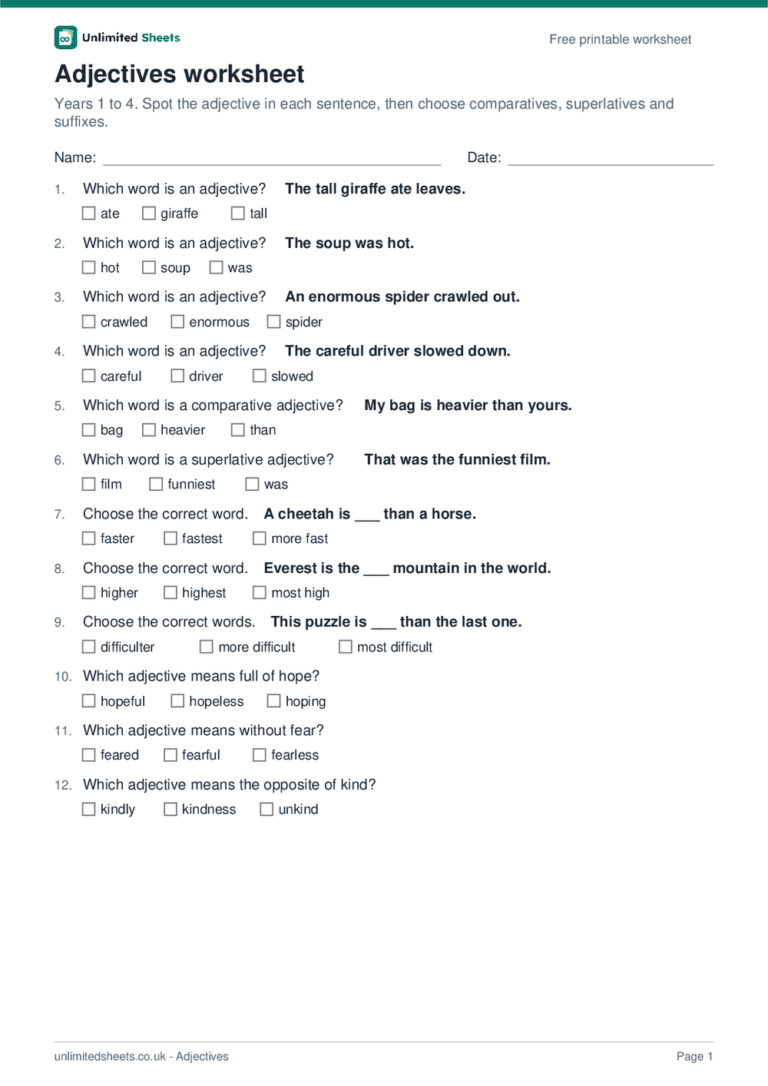
The worksheet mixes questions that ask your child to spot adjectives with questions that ask them to use them, each with tick boxes, followed by an answer key. It is A4 and prints in black and white.
Related pages
- By year: Year 1 English, Year 2 grammar, Year 4 grammar.
- More in Word classes: Modal Verbs, Conjunctions, Prepositions, Determiners, Nouns, Adverbs, Pronouns.
- Other grammar terms: Relative Clauses, Active and Passive Voice, Apostrophes, Inverted Commas, Parenthesis, Homophones. See them all on the KS2 grammar page.
Sources
National curriculum in England: English programmes of study, including English Appendix 2: vocabulary, grammar and punctuation, Department for Education, GOV.UK.
Updated 23 November 2026.