
A pronoun is a word that takes the place of a noun, so you do not have to repeat it. In Grandad found the keys and gave them to me, them stands for the keys, and me stands for the speaker. Children learn the terms pronoun and possessive pronoun in Year 4 and relative pronoun in Year 5.
Try the two practice sets below: Spot it asks your child to find pronouns in sentences, and Use it asks them to choose the correct one. Every answer is explained.
Types of pronoun
| Type | Pronouns | Example |
|---|---|---|
| Personal (subject) | I, you, he, she, it, we, they | They built a den. |
| Personal (object) | me, you, him, her, it, us, them | Mum helped us. |
| Possessive | mine, yours, his, hers, ours, theirs | The blue bag is mine. |
| Relative | who, which, that, whose | The boy who won smiled. |
Words such as my, your and their come before a noun (my bag), so in the national curriculum they are possessive determiners, not pronouns. A possessive pronoun stands on its own: The bag is mine.
Pronouns and avoiding repetition
The Year 4 programme of study asks for an “appropriate choice of pronoun or noun within and across sentences to aid cohesion and avoid repetition”. Compare:
- Ben fed the cat. Ben brushed the cat. Ben put the cat outside.
- Ben fed the cat, brushed it and put it outside.
But too many pronouns can confuse: in Ben and Sam met his dad, whose dad is it? When a pronoun could point to two people, use the noun again.
I or me?
I does the action; me has the action done to it. A quick check is to take the other person out: Dad and I went fishing (I went fishing), but Dad took Amir and me fishing (Dad took me). Since Year 1, children write I with a capital letter.
Relative pronouns
In Year 5, children use relative pronouns to add a relative clause: who for people, which for things, that for either and whose for belonging: the girl whose dog ran away. See relative clauses for more.
Common mistakes
- Me and him went: should be He and I went.
- Apostrophes in possessive pronouns: her's and your's should be hers and yours.
- Which for people: the man which helped should be the man who helped.
Printable pronouns worksheet
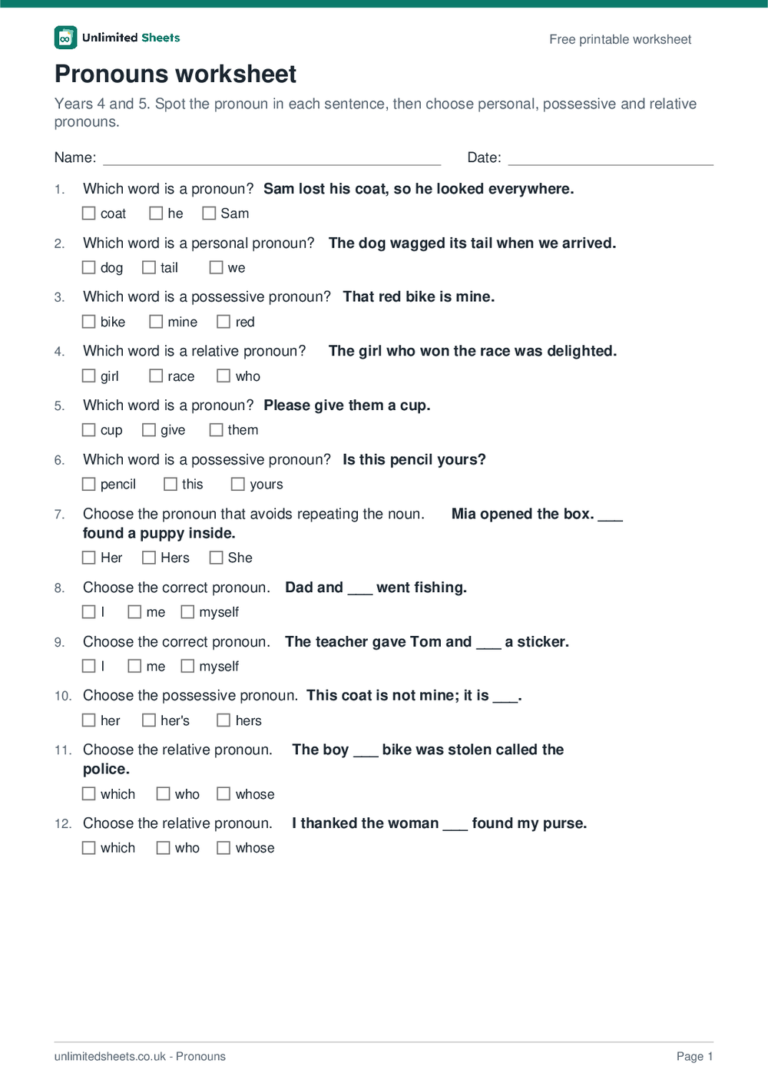
The worksheet mixes questions that ask your child to spot pronouns with questions that ask them to use them, each with tick boxes, followed by an answer key. It is A4 and prints in black and white.
Related pages
- By year: Year 4 grammar, Year 5 grammar.
- More in Word classes: Modal Verbs, Conjunctions, Prepositions, Determiners, Nouns, Adjectives, Adverbs.
- Other grammar terms: Relative Clauses, Active and Passive Voice, Apostrophes, Inverted Commas, Parenthesis, Homophones. See them all on the KS2 grammar page.
Sources
National curriculum in England: English programmes of study, including English Appendix 2: vocabulary, grammar and punctuation, Department for Education, GOV.UK.
Updated 23 November 2026.